© GDPR EU 2026. All rights reserved.

So,When Did GDPR Become Law? The General Data Protection Regulation (GDPR) officially became law on 14 April 2016, when it was adopted by the European Parliament and the Council of the European Union.
However, it did not become enforceable until 25 May 2018, following a two-year transition period that allowed businesses, public bodies, and organisations across the EU to prepare for compliance.
Table of Contents
| Event | Date | Notes |
|---|---|---|
| Adopted by EU Parliament & Council | 14 April 2016 | Legal foundation established. |
| Entered into force | 24 May 2016 | Official publication; start of two-year preparation period. |
| Fully enforceable / applicable | 25 May 2018 | Organisations legally required to comply; fines now possible. |
| UK Data Protection Act aligns with GDPR | 23 May 2018 | GDPR obligations became enforceable in the UK. |
| UK GDPR comes into effect (post-Brexit) | 1 January 2021 | UK continues GDPR framework independently of the EU. |
Quick Summary:
Adopted: 14 April 2016
Effective / enforceable law: 25 May 2018
In short, while GDPR was legally adopted in 2016, it became enforceable across the EU on 25 May 2018, the date most businesses and individuals associate with GDPR “becoming law.”

The GDPR is a regulation of the European Union (EU) designed to protect the personal data of individuals in the European Economic Area (EEA). Its objectives include:
Strengthening individual privacy rights
Harmonising data protection laws across the EU
Regulating international transfers of personal data
Unlike previous EU data protection directives, which required each Member State to create national laws, the GDPR is a regulation, meaning it has direct effect across all EU countries. Organisations processing data in Europe must comply regardless of where they are located.
GDPR has roots in decades of data protection history:
1950: The European Convention on Human Rights establishes a right to privacy.
1970s–1980s: Countries like Germany implement early national data protection laws, developing the concept of “informational self-determination.”
1995: The EU introduces the Data Protection Directive (95/46/EC), setting a baseline for national laws but allowing Member States flexibility.
By the 2010s, rapid technological advancements — including cloud computing, social media, and big data — exposed weaknesses in the 1995 rules. EU leaders recognised the need for a modern, harmonised framework, which became GDPR.
25 January 2012: The European Commission publishes the first GDPR proposal.
2012–2015: “Trialogue” negotiations occur between the Commission, Parliament, and Council.
15 December 2015: European Parliament’s Committee on Civil Liberties, Justice and Home Affairs (LIBE) approves the compromise text.
17 December 2015: The EU’s Permanent Representatives Committee confirms the agreement.
These negotiations shaped key features of GDPR, including individual rights, organisational obligations, and enforcement powers.
| Date | Event |
|---|---|
| 14 April 2016 | European Parliament adopts GDPR |
| 24 May 2016 | GDPR enters into force (20 days after official publication) |
| 25 May 2018 | GDPR becomes fully applicable/enforceable |
| 20 July 2018 | EEA non-EU states apply GDPR |
| 23 May 2018 (UK) | Data Protection Act 2018 receives Royal Assent |
| 1 January 2021 (UK) | UK GDPR comes into force post-Brexit |
14 April 2016: Adoption of GDPR by EU Parliament and Council.
24 May 2016: Regulation formally enters into force.
25 May 2018: GDPR becomes enforceable across the EU — the date businesses and individuals often associate with GDPR’s “start.”
The two-year period between entry into force and full applicability allowed:
Businesses to prepare: Update privacy policies, restructure data processing, appoint Data Protection Officers (DPOs), and implement security measures.
Member States to implement complementary laws: Address national choices allowed under GDPR.
Supervisory authorities to get ready: Prepare enforcement mechanisms and guidelines.
This transition period ensured a smoother adoption across the EU and gave organisations time to comply without immediate penalties.
GDPR revolutionised privacy and data protection:
Right to be informed
Right of access
Right to rectification
Right to erasure (“right to be forgotten”)
Right to restrict processing
Right to data portability
Right to object
Rights in automated decision-making and profiling
Lawful bases for processing personal data
Data protection by design and by default
Record-keeping and accountability
Breach notification within 72 hours
Security measures and risk assessments
Fines up to €20 million or 4% of global annual turnover
Supervisory authorities can investigate and impose corrective actions
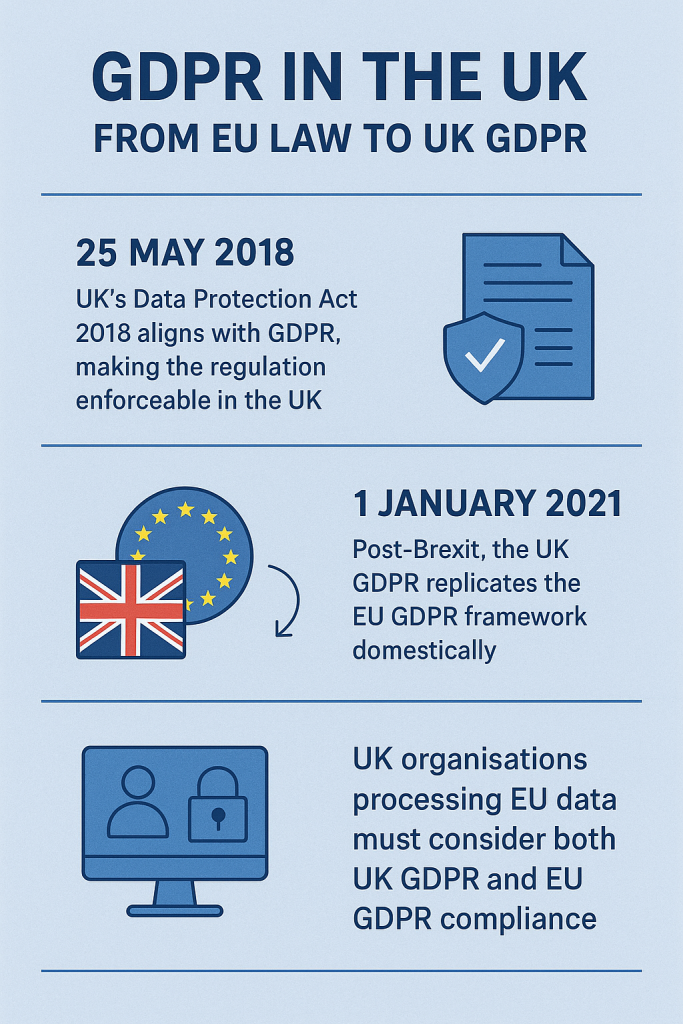
25 May 2018: UK’s Data Protection Act 2018 aligns with GDPR, making the regulation enforceable in the UK.
1 January 2021: Post-Brexit, the UK GDPR replicates the EU GDPR framework domestically.
UK organisations processing EU data must consider both UK GDPR and EU GDPR compliance.
GDPR applies not only in the EU/EEA but also extraterritorially:
Companies outside the EU must comply if they process personal data of EU residents or monitor their behaviour.
Many countries have adopted GDPR-inspired laws, raising the global standard for data protection.
Visual summary of GDPR’s journey:
2012: Proposal published
2015: Trilogue negotiations concluded
2016 (April 14): Adopted by EU Parliament
2016 (May 24): Entered into force
2018 (May 25): Fully applicable/enforceable
2018 (July 20): Extended to EEA non-EU states
2021 (Jan 1): UK GDPR effective
Since 25 May 2018, GDPR has:
Strengthened privacy rights for individuals
Changed organisational practices worldwide
Increased regulatory scrutiny and enforcement actions
Inspired international data protection laws
Introduced ongoing compliance obligations
Marks the start of enforceability
Businesses could face penalties for non-compliance
Individuals could fully exercise their rights
Provides legal certainty for audits, contracts, and liability
Compliance is ongoing, not a one-time project.
Data protection requires technical, organisational, and cultural changes.
National variations exist; consult your local supervisory authority.
Extraterritorial effect means global awareness is essential.
To summarise:
Adopted: 14 April 2016
Entered into force: 24 May 2016
Fully enforceable / applicable: 25 May 2018
The distinction is key: adoption creates the legal foundation, but enforcement and practical obligations began 25 May 2018. This date represents the moment when GDPR truly became law in practice — shaping privacy and data protection across Europe and beyond.