© GDPR EU 2026. All rights reserved.

Article 5(1)(c) of the GDPR says personal data shall be “adequate, relevant and limited to what is necessary in relation to the purposes for which they are processed (‘data minimisation’)”. The official text is at eur-lex.europa.eu/eli/reg/2016/679/oj.
Necessary for what? Ask it of any site that wants something before it shows you a profile. I asked two “private Instagram viewer” sites from the first page of results, from a Dutch connection, typing nothing into either. Their own pages did most of the answering.
Table of Contents
Goonview’s home page is headed “Private Instagram Account Viewer”, and a card reads “Public pages? Easy. But private ones? Also, no problem.” Its About page says “Goonview does not bypass Instagram’s privacy controls.”
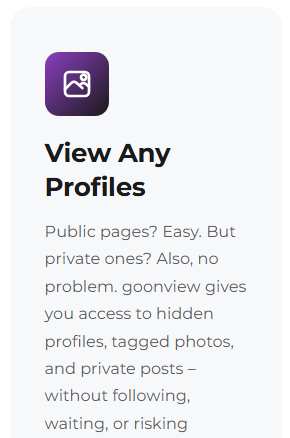
A card on Goonview’s home page: “But private ones? Also, no problem.” It goes on to promise “hidden profiles, tagged photos, and private posts”.
privatephotoviewer.com holds both positions on one page. One paragraph says “IG Profile Viewer can get any media , stories from any Instagram account( public or private ) in moments.” Further down, twice: “Only private accounts are inaccessible.”
Instagram does not hand a stranger a private post. Both sites admit it.
One Goonview testimonial reads “I used their viewer tool to see his other account despite his denials.” If your own account is followers-only, the retractions above are your answer.
Recital 30 counts “internet protocol addresses, cookie identifiers” among the online identifiers a person may be associated with, so no visit is data-free. Beyond that, it depends which page you read.
| Goonview | privatephotoviewer | fastdl | |
| Front page says it opens private accounts | yes | yes | no (FAQ: “FastDl only works with public Instagram accounts”) |
| Another page on the same site says it cannot | yes (About) | yes (same page) | no claim to withdraw |
| Asks for your Instagram password | terms: yes; FAQ: no | no (“No sign-ups. No passwords.”) | no (“FastDl never asks for your Instagram password”) |
| Asks for an account or an email | terms: an account and a valid email | terms: valid email, secure password | no sign-up form in five measured runs |
| Where the flow ends | page and script: an “unlocking package”, then a page that is one third-party script | not tested | its own signed, expiring download link |
Goonview’s FAQ: “Goonview doesn’t ask for your Instagram username nor password.” Its terms: “We require your Instagram username and password to obtain the required information for the Instagram API.” The terms also mention “payment of the applicable fees”, and the home page’s step three reads “Sign up for a subscription.” I found no price anywhere.
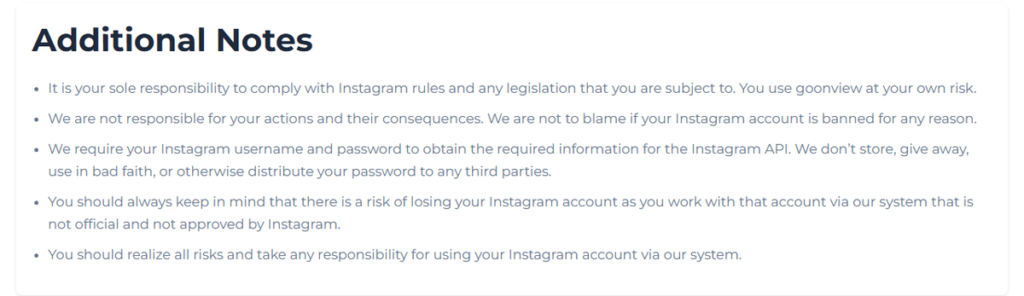
The “Additional Notes” in Goonview’s terms. The third bullet asks for your Instagram username and password; the fourth warns of “a risk of losing your Instagram account”.
Goonview’s “View Profile Now” button leads to a “Private Profile Unlocker” page. It asks for the “Instagram username of a private account”, then an “unlocking package”. I typed nothing and read its script.
The page’s own code runs the bar on a timer: one percent every 125 milliseconds. Nothing in that loop waits for a server. Meanwhile 19 fixed lines styled as program output scroll past, “Successfully unlocked profile” appears at 95 percent, and a “people are currently using Goonview” counter starts at a random 11 to 49. Then “Fetching Profile…” for 2,000 milliseconds, and the browser lands on a page of 166 bytes: a noindex tag and one script from verifymecloud.site. What that script shows, I did not see.
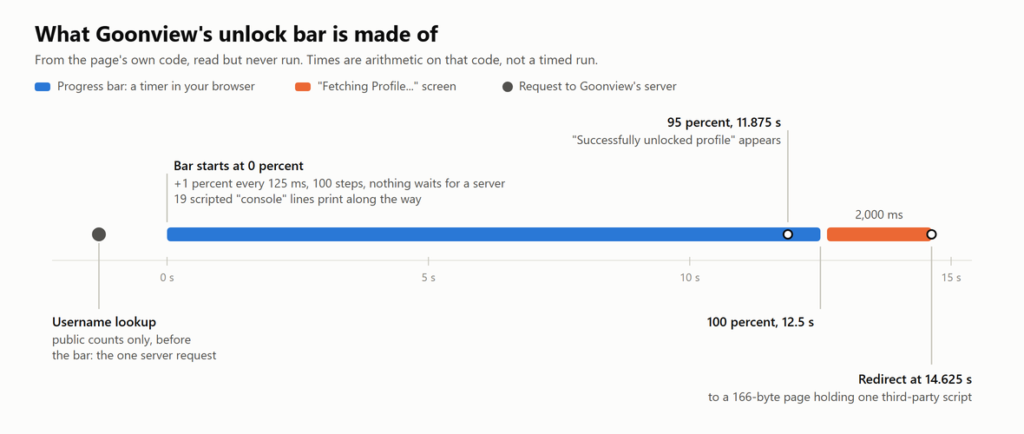
Read from the page’s script, never run. A timer fills the bar, “Successfully unlocked profile” is written at 95 percent, and a short “Fetching Profile…” screen hands the browser to a 166-byte page.
Goonview’s privacy policy describes third-party offers. A provider “may collect information such as your IP address, device information, email address, survey responses, app activity”, and completing one “does not guarantee access to private or restricted Instagram content.” Read that next to Article 5(1)(c).
Article 13(1) lists “the identity and the contact details of the controller” and “the purposes of the processing for which the personal data are intended as well as the legal basis for the processing”. Recital 32: “Silence, pre-ticked boxes or inactivity should not therefore constitute consent.”
privatephotoviewer’s privacy policy is dated 2018, names no company or address, and never mentions GDPR or a legal basis. It reads “By using the Service, you agree to the collection and use of information in accordance with this policy.” The posts page promises “No login. No tracking.” The policy says “We use cookies and similar tracking technologies to track the activity on our Service”. A 2024 disclaimer adds “We comply with: GDPR requirements”.
Goonview’s notice is the best drafted of any site in this article. It is dated 2026, names GOONVIEW LLC in Manchester as controller, pairs six purposes with a legal basis each and keeps support emails for 12 months.
Then the practice. Where consent is legally required, it says, analytics run “only after the visitor provides consent through the cookie controls”, via a “Manage Cookie Preferences link in the website footer”. The footer reads “Terms of Use / Privacy Policy”. On each of my three visits from a Dutch connection no banner appeared, and a Google Analytics request went out before any click. The policy still holds 10 unfilled template placeholders.
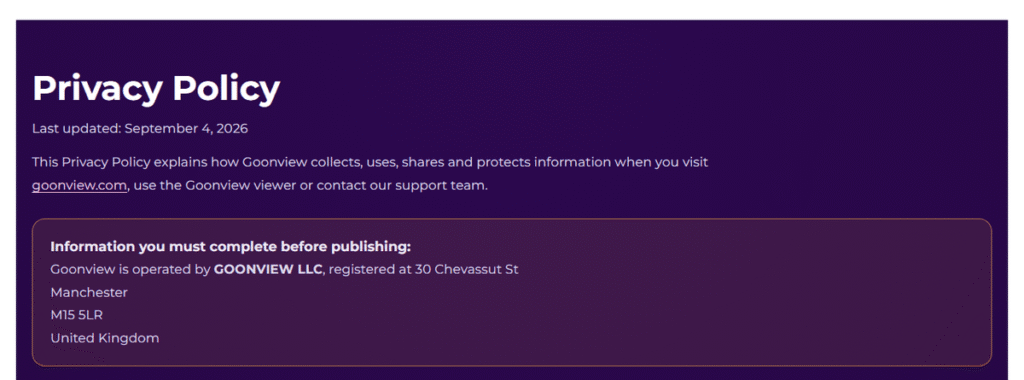
Dated 2026 and naming a controller with a Manchester address, the top of Goonview’s privacy policy still shows the template’s instruction: “Information you must complete before publishing:”.
In fairness, privatephotoviewer sent no tracking request on my two visits without a click. Its scripts wait for a scroll or click I never made, so what a real visitor gets is not measured.
Without the private promise, the only content any tool can fetch is content its owner made public. fastdl’s viewer page answers “Can I view private accounts?” with “No”, and adds: “FastDl won’t get around a follow request, a password, or a privacy setting, and you should distrust anything that says it can.”
Its form asks for a public post link or a username, nothing else. In five measured runs no login or sign-up form appeared. If what you wanted was a public reel, you can download instagram reels online with nothing but its link, and what comes back is fastdl’s own signed, expiring download link, not someone else’s page. That is my whole claim: the least asked, at the moment of use. The usual rule holds: your own clips, or someone else’s with their say-so.

From the FAQ on fastdl’s viewer page: “No login is ever required. FastDl never asks for your Instagram password.” The answer to the last question sits just below this crop; on the page it begins “No. FastDl only works with public Instagram accounts”.
Three questions to put to any viewer site before typing a thing.
Does any page of the site admit it cannot open private accounts? If the front page says yes and the About page says no, believe the About page.
What does it want before it shows anything, and is that “limited to what is necessary” for a public link? A password, an email, a subscription or a survey is more than a public link needs.
Does it finish the job itself, or hand you to someone else? A download link from the site is one thing. An “unlocking package” or a third party’s page is another.